How to Choose Evaporative Humidifiers for Easy Output Control
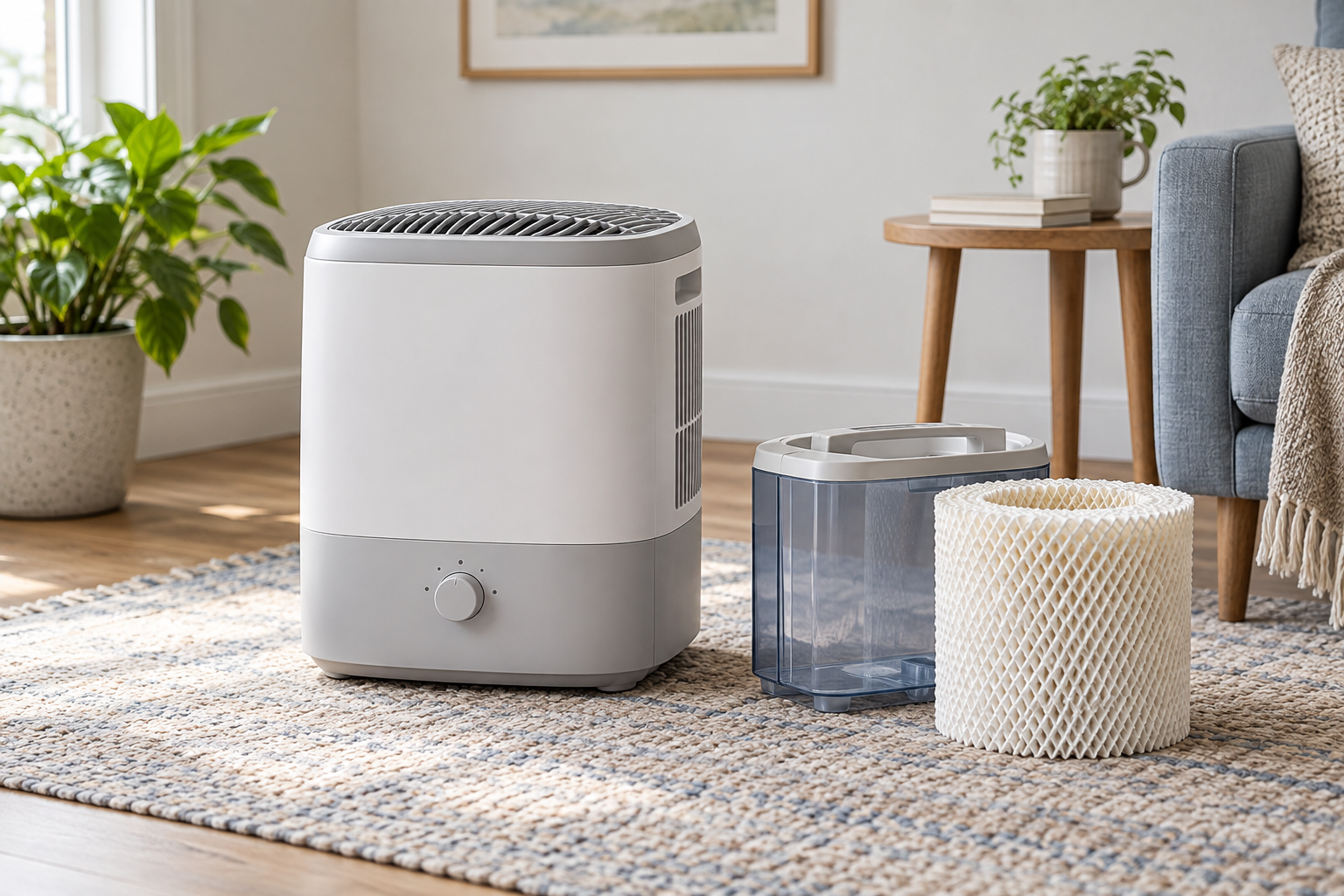
The best evaporative humidifier is not simply the one with the largest tank. It is the model whose documented room and output basis fits the space, whose fan and humidistat controls are easy to adjust, and whose tank, basin, intake, and wick can be maintained without turning every refill into a project. Evaporative designs use a fan to move air through a wet wick, so fan sound and replacement-wick supply are part of the buying decision.
As an Amazon Associate, The Good Home Doc may earn from qualifying purchases.
Quick decision before shopping
First measure the available space, identify the setup or surface constraints, and decide who will maintain the item. Skip the category if it blocks access, conflicts with the manufacturer's instructions or lease, or adds more upkeep than the problem justifies.
Compare only after measuring the room and checking the upkeep: Browse category: Browse evaporative humidifiers with output controls.
This is a product-category shortcut, not a tested ranking. Verify the current manual, stated room or output basis, humidistat behavior, fan settings, tank and basin access, approved wick model, replacement supply, cleaning instructions, noise basis, and placement clearances.
A humidifier is a comfort appliance, not a treatment or a repair. Follow the current instructions for the exact unit and use an independent hygrometer if you need a separate room reading. Stop adding moisture when condensation or damp surfaces appear, and involve the property manager or an appropriate qualified professional for persistent dampness, leaks, visible damage, or unexplained odors.
Choose the control system before the extras
| Control format | Best fit | Main tradeoff |
|---|---|---|
| Manual fan settings | A room where someone can check conditions and adjust low, medium, or high output | Simple controls, but output changes depend on the user |
| Built-in humidistat | A routine that benefits from cycling around a selected humidity setting | Sensor location and control increments may differ from a separate room reading |
| Console with several tanks | A larger documented use case where longer refill intervals matter | More floor space, more parts to fill and clean, and heavier water handling |
A humidistat is useful only when its settings and indicators are understandable. Check whether the display shows a measured value, a target, or both; what adjustment increments are offered; and how the fan behaves near the target. Do not assume an automatic setting removes the need to watch the room for condensation or maintain the appliance.
Verify the room-size and output basis
Manufacturers may describe coverage using room area, ceiling assumptions, output over time, test conditions, or broad labels. Compare models only when you understand the basis and it resembles the intended room. An open-plan area, open door, tall ceiling, strong air exchange, and very dry conditions can change the real routine.
Choose a manageable appliance rather than buying the largest claim. Mark the complete footprint on the floor, including air intake and outlet clearance, control access, tank removal path, cord route, and a level water-resistant surface permitted by the manual. Keep the unit away from places where discharge or spills could affect walls, furniture, textiles, electronics, or walked-through areas.
Make tank and basin access a must-have
Inspect the refill path before comparing capacity. A tank needs to fit beneath the available faucet, sit steadily during filling, and travel from sink to appliance without an awkward grip. Check the filled weight you would actually carry; water capacity that reduces refill frequency also increases handling weight.
Look for openings wide enough to reach the surfaces the maker tells you to clean. Confirm whether the tank stands on its own, whether a cap is easy to grip, and whether the basin, float, grille, and fan intake are accessible as directed. A hidden ledge or narrow channel can make an otherwise capable unit a poor daily fit.
Budget for the wick, not just the machine
The wick is a recurring supply. Before buying, identify the exact approved replacement model, how many the appliance uses, where it is sold, and the maker's replacement cues. Treat a time estimate as conditional: water quality, use frequency, cleaning, and room conditions can change wick life.
Do not assume a discolored or stiff wick can be restored with an improvised chemical treatment. Follow the manual for soaking, flipping, cleaning, drying, and replacement. If replacement wicks are hard to identify or the ongoing supply cost breaks the household budget, skip the appliance even if its purchase price looks attractive.
Compare fan sound honestly
An evaporative humidifier moves air with a fan. Check whether noise information names the fan setting and measurement basis; a single unlabeled number is not enough to predict bedroom comfort. A low setting may be easier to live with but may also move less moisture, so compare sound and output as one tradeoff.
Listen for control beeps, cycling, water movement, and display brightness in addition to fan noise. For a bedroom, simple controls and a usable low setting may matter more than a long feature list. For a living area, access and refill convenience may be the stronger priority.
Must-haves and nice-to-haves
Must-haves
- A complete current manual with clear placement, water, cleaning, wick, inspection, and storage instructions.
- A documented output or room-size basis that can be compared with the intended space.
- Fan and humidity controls the household can understand and reach.
- A tank, basin, wick, intake, and grille that can be serviced as instructed.
- An identified replacement wick with a realistic ongoing supply route.
- A stable footprint and direct cord route that stay clear of water, walkways, and heat sources.
Nice-to-haves
- A separate low-fan or sleep setting with documented display behavior.
- Handles that support the maker's instructed tank-removal and carrying method.
- A refill indicator and easy-to-see water level.
- Simple cord storage for the cleaned and fully dry off-season appliance.
Who should skip an evaporative humidifier?
- Anyone trying to solve a leak, persistent dampness, window condensation, musty surfaces, or a ventilation problem by adding more moisture.
- Households unwilling to clean the tank and basin and inspect or replace the wick on the instructed schedule.
- Rooms without a permitted level location, appropriate clearance, and a direct cord path.
- Light sleepers who cannot tolerate fan noise and cannot verify an acceptable low setting.
- Anyone unable to handle the filled tank safely or source the exact replacement wick.
- People seeking medical treatment, sanitation, aromatherapy, or additives that the appliance instructions do not support.
Bottom line
Choose an evaporative humidifier by control clarity and maintenance fit first. A useful model has a documented output basis, sensible fan settings, an understandable humidistat when needed, a tank and basin you can actually clean, and replacement wicks you can identify and afford. Skip oversized capacity, vague coverage promises, and smart extras when the water path, sound, consumables, or room placement do not work in daily life.