How to Choose Entryway Key Organizers for Renters
The best key organizer for a renter is the one household members will use on the way through the door without risking the finish, interfering with the door, or becoming a catchall. A small tray is the lowest-risk starting point when you have a console; over-door and removable wall organizers can save surface space, but only after you check clearance, attachment limits, and the lease.
As an Amazon Associate, The Good Home Doc may earn from qualifying purchases.
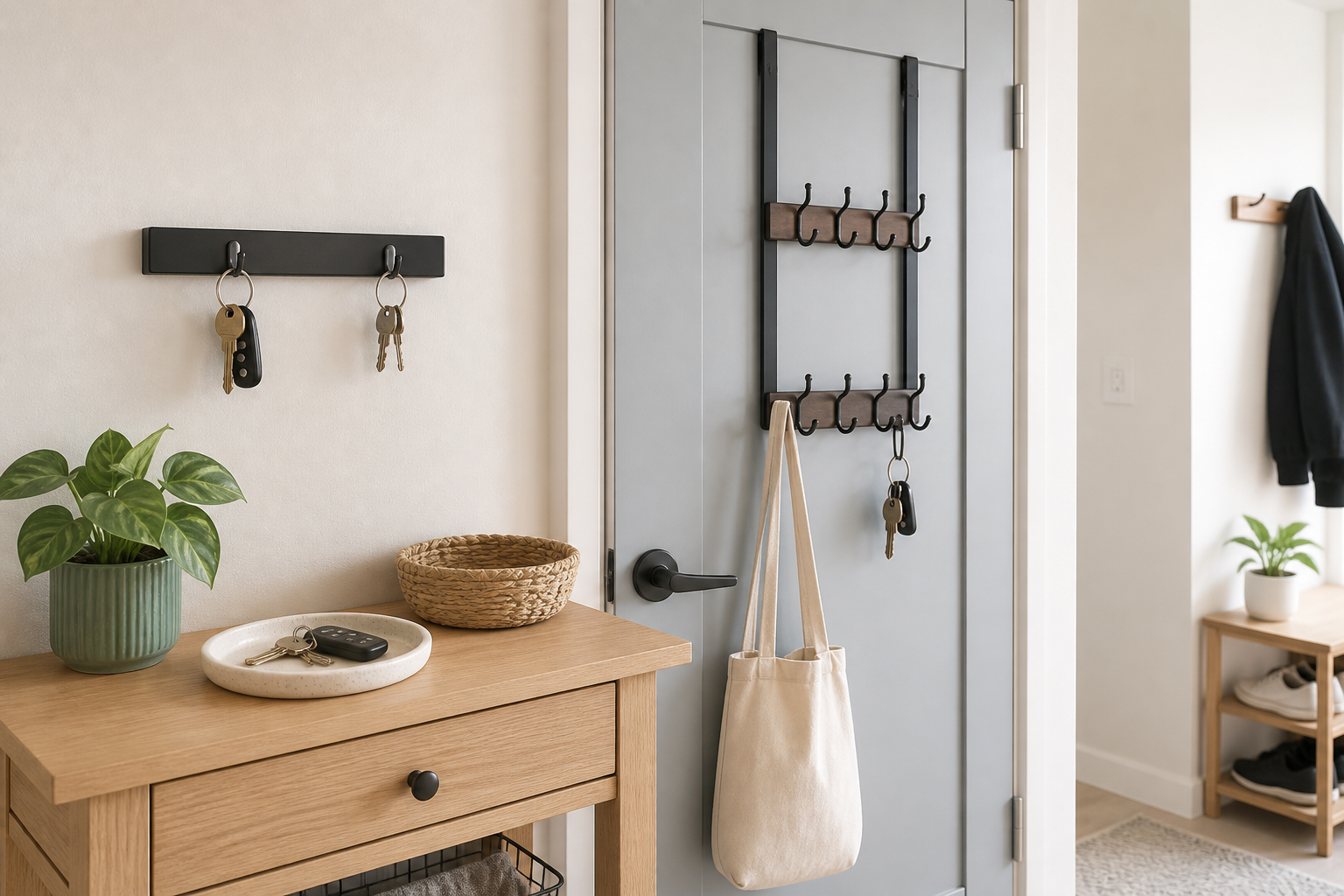
Quick decision before shopping
First measure the available space, identify the setup or surface constraints, and decide who will maintain the item. Skip the category if it blocks access, conflicts with the manufacturer's instructions or lease, or adds more upkeep than the problem justifies.
Compare the format that fits your entry: These affiliate searches are category starting points, not tested product rankings.
- Browse category: Freestanding entryway key traysCompare usable tray area, lip height, cleanability, grip, and console footprint.
- Browse category: Removable-adhesive key holdersCheck the maker's surface rules, stated load, removal method, hook spacing, and wall-finish risk.
- Browse category: Over-door key organizersMeasure door thickness, top and side clearance, hook projection, and movement before buying.
Confirm current dimensions, materials, attachment instructions, stated limits, and return terms on the listing or maker documentation. Test any removable attachment only as directed and with the property owner's rules in mind.
This guide compares organizer formats and fit criteria rather than naming current product winners. It excludes key safes, locks, hidden-key products, smart access devices, and claims that an adhesive or magnetic attachment will be damage-free on every surface.
Quick Picks by Entryway Setup
- Best for the lowest attachment risk: a shallow tray on an existing stable console, shelf, or cabinet.
- Best for a metal surface: a compact magnetic holder whose magnet and backing are suitable for that finish.
- Best for a clear wall near the door: a light removable-adhesive rail used only on a surface allowed by its instructions and the lease.
- Best when wall attachment is off limits: an over-door organizer that clears the frame, seals, hardware, and normal door swing.
- Best for keys plus mail or wallets: a small tray-and-hook station, provided every compartment has a specific daily job.
Choose the Landing Spot Before the Organizer
Watch where keys already land for several days. The most useful location is usually within an easy reach of the normal entry path but outside the door swing, lock hardware, and narrow walking route. Avoid placing keys where they are plainly visible or reachable from an exterior window, mail slot, or open doorway.
Measure the available wall, door, or console area. For a tray, include space to lift items out without knocking over a lamp or plant. For hooks, measure the longest key ring and fob so they do not strike the wall, door handle, or another set of keys.
Comparison Framework
Freestanding Trays and Bowls
A tray avoids attachment questions and is easy to move at the end of a lease. A shallow divided tray can separate keys from a wallet or access card, while a higher lip helps contain bulky fobs.
Choose one when: you already have a stable surface beside the normal entry path.
Watch for: a footprint that crowds the console, rough undersides, fabric that traps grit, or a bowl deep enough to hide smaller keys.
Removable-Adhesive Hooks and Rails
These preserve surface space but make the wall finish part of the buying decision. Read the current surface, preparation, cure-time, load, and removal instructions before choosing a location. Paint condition, texture, moisture, temperature, and previous repairs can all affect the result.
Choose one when: the lease permits it, the surface matches the maker's instructions, and the combined key weight stays comfortably inside the stated limit.
Watch for: fresh or weak paint, wallpaper, textured surfaces, humid locations, overloaded catchall baskets, and removal that requires pulling in a direction blocked by trim.
Magnetic Holders
A magnetic organizer can work on a compatible steel door or cabinet without adhesive. Test whether the chosen surface attracts a magnet and confirm that contact will not scratch or mark the finish.
Choose one when: a suitable metal surface sits near the entry path and the organizer stays stable during normal use.
Watch for: nonmagnetic doors, weak contact on curved panels, grit trapped behind the magnet, and sliding when keys are removed sideways.
Over-Door Organizers
An over-door format uses vertical space without wall adhesive, but the bracket must fit the actual door and frame. Measure door thickness and the gap above it, then confirm the door closes and latches normally without rubbing or forcing the hardware.
Choose one when: the door has adequate clearance and the hanging keys will not hit the wall, glass, trim, or handle.
Watch for: rattling, finish wear, compressed weather stripping, blocked closure, and bags or coats that bury the keys.
Must-Have Criteria
- A realistic capacity: count everyday key rings and measure the bulkiest fob rather than relying on a hook count alone.
- Safe placement: keep the organizer clear of the latch, hinges, electrical controls, door swing, and walking path.
- Compatible attachment: match the product's current instructions to the exact wall, door, metal finish, or furniture surface.
- Easy one-handed use: each key set comes off without pulling neighboring rings down or sliding the organizer.
- Contained small items: trays need enough lip to hold the intended fob or card without becoming a miscellaneous junk pile.
Nice-to-Have Features
- Spaced hooks that prevent bulky fobs from overlapping.
- A washable or wipeable tray insert.
- A padded magnetic backing suitable for the surface.
- A small cable opening if a rechargeable tracker is stored there.
- Replaceable attachment strips specified by the organizer maker.
Setup and Removal Checks
Before installation, read the lease and the organizer instructions. Clean and prepare only as directed. Do not improvise with stronger tape, extra adhesive, screws, or anchors when the product is designed for another method. Load wall or magnetic organizers gradually, then confirm they stay put during normal key removal.
Save the removal instructions and any required pull-tab clearance. If the paint is already peeling, the wall is damp, the door no longer closes normally, or removal could expose an underlying repair, stop and ask the property owner or manager before proceeding.
Who Should Skip a Key Organizer
Skip a wall-mounted option if the lease prohibits attachments, the finish is fragile, or the only available spot exposes keys near exterior access. Use a movable tray inside a cabinet or another controlled location instead. Skip an over-door option if it changes how the door closes, rubs the frame, or swings the keys into a hard surface.
A dedicated key organizer may also be unnecessary for a household with one small key ring and an established secure drawer. If the real problem is mail, bags, schedules, and several people's belongings, a measured entryway command center may be more useful than adding several small organizers.
Bottom Line
For most renters with a narrow console, a small stable tray is the simplest and most reversible choice. When surface space is scarce, choose a magnetic, removable-wall, or over-door organizer only after confirming the exact surface, stated limits, door clearance, removal path, and lease rules. The right format makes keys easy to drop and retrieve without creating a new wall, door, or clutter problem.